
Elgin City Directory Runs
Gail Borden Public Library describes its Elgin city directory holdings as running from 1875 to the present. An official Illinois Geological Survey bibliography provides the detailed publisher sequence through 1974. That combination gives a strong shelf map, but the publisher and exact year availability after 1974 still need confirmation from library staff.
| Collection | Years | Where held | Access |
|---|---|---|---|
| Lord & Bradford and Holland runs | 1875-76; 1878-79; 1881-82 | Gail Borden local-history holdings | Library collection and staff help |
| Kepstine, Donnelley, Simm & Youngs | 1884-85; 1885; 1887-88 | Library collection | Check title page because coverage and publisher vary |
| Finney & Jones directory | 1892 | Elgin History Museum index and local holdings | Free online old/new address search; source volume locally |
| Evans and local directory companies | 1894-1944, in several runs | Gail Borden and local-history collections | Name search; address indexing becomes useful from 1900 |
| Polk directories | 1948-49; 1951-74 | Gail Borden local-history holdings | In-person collection; nearby communities appear in some years |
| Later Elgin holdings | 1975-present library statement | Gail Borden Public Library | Confirm each year and publisher before citing |
The series is not one uniform publication. Some titles include South Elgin, Carpentersville, Dundee, or other nearby places. Same-year editions can have different publishers. Treat the title page, coverage note, year, and page as part of every citation.
Publishers Shape Elgin Directories
The publisher trail explains changes in layout and geographic reach. It also guards against assuming that two volumes with close dates use the same abbreviations or include the same communities.
| 1875-1882 | Lord & Bradford opens the located run, followed by Holland Publishing Company. |
|---|---|
| 1884-1892 | Several publishers appear, including Kepstine, R.R. Donnelley, Simm & Youngs, Ross Dickson, Overman, and Finney & Jones. |
| 1894-1946 | Evans names dominate long stretches, mixed with City Directory Company, Elgin City Directory Company, and McCoy. |
| 1948-1974 | Polk supplies the long mid-century sequence after an Evans & Johnson volume in 1946. |
| After 1974 | The library states that holdings continue, but the inspected official bibliography does not settle publishers or every available year. |
Publication gaps are not proof that a person left Elgin. Check whether a volume was issued, whether the library owns it, and whether the person was omitted. Then test a newspaper, census, vital index, deed, or church record for the same span.
Read an Elgin Directory Entry
A city directory entry must be transcribed as printed. The unattended research did not expose a safe sample row from the 1892 form, so no invented example belongs here. Instead, capture the actual fields and symbols that the chosen volume provides.
| Name | Record spelling, initials, and order exactly as printed. |
|---|---|
| Household clue | Note a spouse, relative, widow notation, or other relationship only when the entry states it. |
| Work or group | Transcribe occupation, firm, organization, or other affiliation without expanding an unclear abbreviation. |
| Address | Save street number and street name in the historic form used by that volume. |
| Status mark | Record owner, renter, boarding, or householder symbols only when defined in that edition's key. |
| Citation | Keep volume year, publisher, page or section, and the access copy used. |
- Criss-cross directory
- A directory arranged by address or telephone rather than just surname. A separately catalogued Elgin criss-cross run was not confirmed.
- Householder index
- An address-ordered section that identifies the listed household or business at each numbered property.
- Abbreviation key
- The volume's own list of shortened terms and marks. Save it before interpreting a symbol.
A directory is not a census. People may be omitted, addresses can be old, and a listing can describe a business rather than a home. The printed year and publisher control what the entry can prove.
Elgin's 1892 Address Bridge
Elgin renumbered streets in the 1870s, 1884, and 1894. One building may therefore have three historical numbers. The Elgin History Museum 1892 search is an unusually good bridge because its form accepts Resident Name, Current or Old Street Number, and Current or Old Street Name. The address inputs search old and new forms.
The manifest captured the museum's 1892 Elgin directory search.
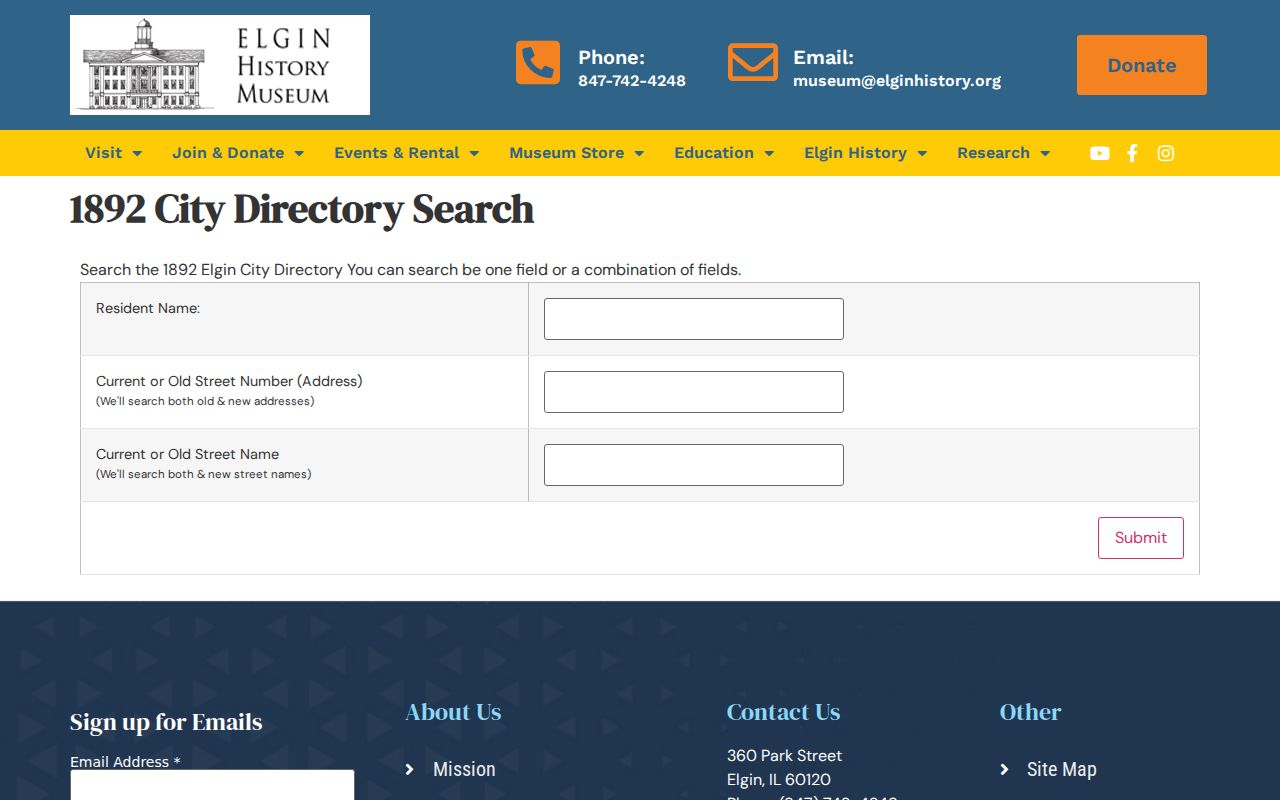
The paired fields explain why a current address can find an older listing when a plain text search fails. The form did not yield a captured sample entry in the research run, so verify the result and preserve its printed source before citing a person.
Old street aliases matter too. Main became State, Broadway became North State, Dexter became National, and River Street split into Hendee and Grove. Search each documented form and keep the exact spelling shown in the volume.
Gail Borden's Elgin Directory Room
Gail Borden Public Library genealogy services are on the second floor. The collection holds more than 4,400 books and thousands of microfilm items. It is also a FamilySearch affiliate and offers one-on-one librarian help, local records, the Elgin Newspaper/Vital Index, and historic newspaper resources.
The manifest image comes from the Gail Borden genealogy and local-history page.
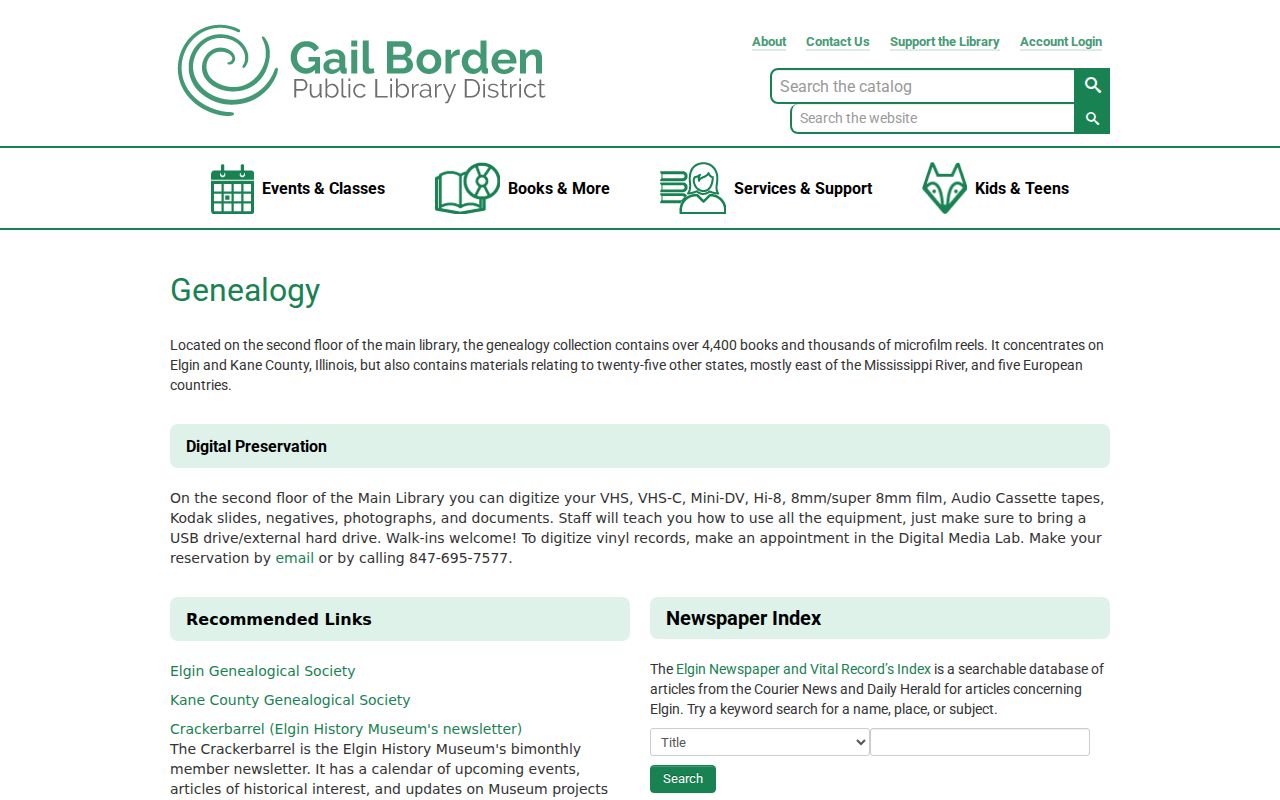
The page represents the collection's main access point. Full digitized newspaper images may be available only inside the library, and microfilm or a bound volume may still be the only route for a particular year.
When repeated online searches fail, call the Information Desk at 847-429-4680 for an appointment. Staff can connect directories to maps, atlases, newspapers, construction reviews, census material, and county records. That handoff is part of the search, not a last resort.
Note: Record the format used, since a web index, bound volume, microfilm reel, and staff transcript are not interchangeable citations.
Digital Clues Beyond Elgin Directories
Gail Borden's Illinois Digital Archives gateway links photographs, Elgin Area History, and WatchWord. Elgin Area Memories is described as a round-the-clock digital collection with newspapers, architecture, religious and social material. These sources do not replace a city directory, but they can explain a listed firm, congregation, school, or civic group.
WatchWord covers 1921 through 1956 except 1933 through early 1935. A card index plus print or microfilm can help fill that gap. School yearbooks add another dated layer: Elgin High's Maroon from 1912, Larkin's Cerulean from 1963, and South Elgin's Vortex from 2006, subject to year-by-year availability.
A new local window opened in 2026 when Gail Borden announced digitization of the Elgin Dairy Report for 1892-1903 through a state grant. Pair a directory business name with that report and a newspaper item. Keep each source's date and do not infer that every person linked to an industry lived at a given address.
Elgin Archives Fill Directory Gaps
The Elgin History Museum house-research service uses its Reber Research Library, directory tools, building files, and volunteer knowledge. Custom research is listed at $10 per home plus $5 admission, limited to one address per month. Appointments for the third-floor research library use 847-742-4248. This is local historical help, not an official title search.
The Elgin Genealogical Society databases reach into obituary, probate, divorce, church, cemetery, funeral, military-post, and township name-change material. Its Conn-Schmidt/Stout funeral index covers records from 1929-1953 and indexing through March 31, 1974; volume 12 is missing. Copy routes and fees vary, and spelling variants must be tested.
The manifest captured the Elgin Genealogical Society research database index.
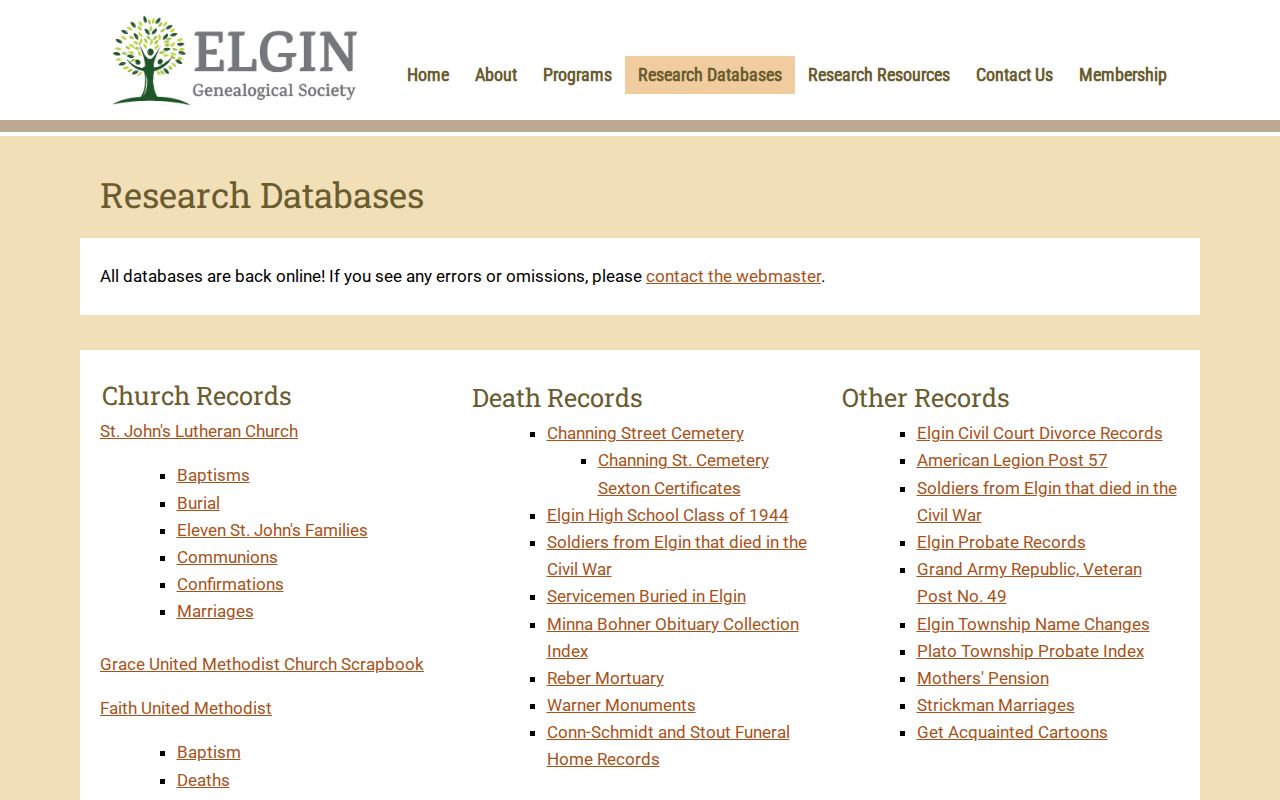
These records can explain why a person disappears from a directory, but each has different coverage. A funeral index, obituary, cemetery record, and death certificate are separate documents and should never be merged into one unsupported claim.
Trace Family Through Elgin Directories
City directories fill the spaces between census years and can mark moves within Elgin. They work best as a year-by-year sequence in which every absence remains an open question until another record supplies an explanation.
- Find the earliest likely surname entry. Save initials, occupation or organization, address, publisher, year, page, and abbreviation key.
- Move forward one available volume at a time. Note address changes, spelling changes, spouse or widow notations, and the first or last appearance.
- From 1900 forward, use the verified address-index method to see who else was listed at the same number. Do not claim a separate criss-cross volume unless the library confirms it.
- Compare the nearest federal census and the Illinois 1855 or 1865 census where relevant. A census can add household relationships that a directory may omit.
- Test the trail against newspapers, obituaries, cemetery records, probate files, deeds, church registers, or yearbooks, depending on the dates and question.
A missing entry can mean a move, death, omission, publication gap, or a name filed differently. Kane's 1843 and 1890 fires also explain some gaps in early court and property trails, though they do not prove why a directory listing is missing. State archives and IRAD preserve other Elgin municipal, court, and burial series.
Date Every Elgin Directory Match
An Elgin city directory records what one publisher printed for one issue. It cannot prove that a person remains at the address now. A telephone number, occupation, spouse notation, or owner mark may also change meaning across editions. Photograph the title page and abbreviation key, then cite the entry page.
To examine a present-day address, move to the Elgin street directory records, where assessor and parcel systems provide modern property labels. For one named person, later verification belongs in the Elgin resident lookup. Those sources still require county, date, and field-level care.
Use dated evidence. A historical listing is valuable for family and local research, but it is not proof of a current household.
Remote access also has limits. Some indexes are online, some full newspaper images are library-only, and some museum or genealogy files require an appointment, mail, email, phone, or a paid copy request. Illinois FOIA applies to government-held records, not to private historical society or library collection scans.